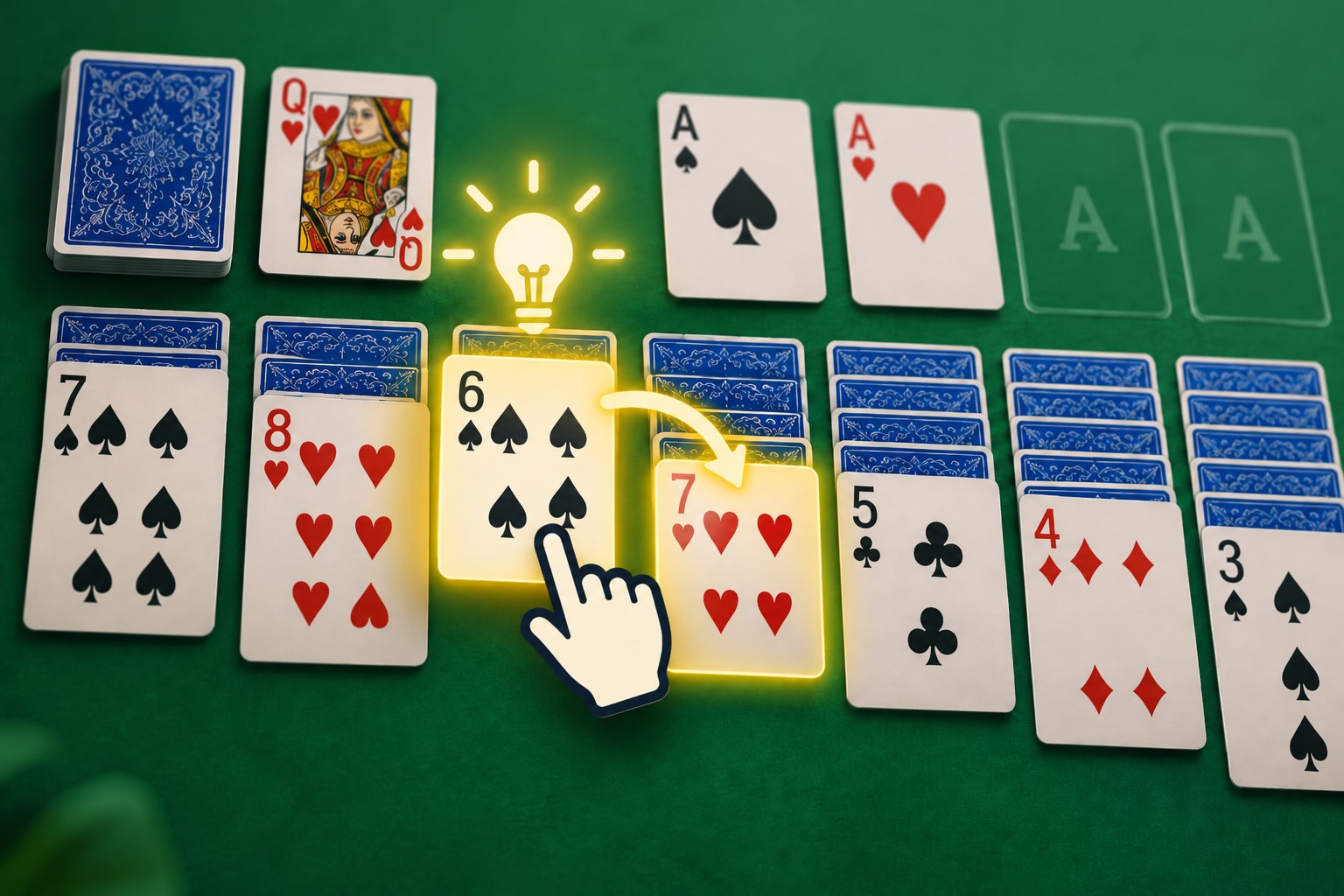
You have checked the board twice. Nothing seems to fit, yet the hint button points to a move you missed. That is useful. The harder question comes next. Will moving that card change your options, or will it merely rearrange the same problem?
Browser Klondike offers a simple way to explore that distinction. In PlaySolitaire, the Hint control suggests an available move or points towards the stock without moving the cards for you. That pause between seeing a suggestion and carrying it out is where the puzzle remains yours. You can inspect the destination, look underneath the moving card and decide what the move would accomplish before committing.
A hint is most useful when it answers a question about the position. It becomes less useful when pressing it replaces the question entirely.
Read the move before making it
Start by naming what the suggestion shows. Is it a tableau move, a card going to a foundation, or a prompt to draw from the stock? Those actions serve different purposes. A move that uncovers a hidden card gives you new information. A foundation move advances a suit. Drawing changes which stock card is available.
Klondike builds tableau sequences downwards in alternating colours, while foundations build each suit upwards from its ace. These rules explain whether a move is permitted. They do not, by themselves, explain whether it is the most useful move in the current position.
Try putting the hint into a short sentence before acting. “This red six can go on that black seven, and moving it will uncover a card.” If the sentence ends after “can go”, look again. You have described permission, not a reason.
Compare two legal moves
Imagine a red six lying on top of a hidden card in one column. Elsewhere, another red six sits at the bottom of a visible sequence. A black seven is available as a destination. Either six could fit, but moving the first would expose a card, while moving the second would not reveal anything immediately.
The first move has a clear immediate benefit. That does not prove it wins the deal. Perhaps moving the other six makes a different card playable from the waste, or frees a sequence you need to move next. The point is to compare consequences rather than treat a highlighted card as a complete explanation.
After following a suggestion, check the resulting board. Did you uncover something? Did an empty column become available? Did you create a place for a card that was previously stranded? A hint becomes an opportunity to understand the position when you connect the suggested action to a visible result.
Separate an oversight from a decision
Sometimes the hint solves a straightforward oversight. You failed to notice a black nine that could accept a red eight, or forgot that the top waste card was playable. In those cases, the useful lesson is about how you scan the board.
Sometimes you saw the move already and chose not to make it. That is a different problem. Perhaps a low card can move to a foundation, but keeping it in the tableau leaves a landing place for another card. Now you need to weigh options, not discover a rule you overlooked.
Before asking again, decide which situation you are in. If a move was invisible to you, inspect why. If you deliberately rejected it, identify what you are waiting for instead. “I am keeping this card here to receive that one” is a more useful explanation than “the hint must be wrong”. It also gives you something specific to reconsider when the board changes.
When a hint sends you back to the stock
A stock suggestion can feel disappointing because it offers no dramatic rearrangement. Still, drawing is part of the puzzle. The top card of the waste is the one available to play, so a useful card can remain inaccessible until the stock cycle exposes it.
Check the selected draw mode before interpreting the suggestion. Drawing one card and drawing three do not present the waste in the same way. Do not borrow advice about access from one setting and assume it applies unchanged to the other.
More importantly, keep the claim small. A suggestion to use the stock is not evidence that the deal can be won, or that every other possible continuation has been ruled out. Unless a particular game explicitly promises a solver, its hint should not be treated as a certificate of success.
Keep the next question yours
You do not need to ban hints to preserve the challenge. Instead, give the button a job. Use it to check for a missed move, then stop and explain the suggestion. Look for what it reveals, what it frees and what it leaves blocked.
The next time the highlighted move feels obvious, resist pressing again immediately. Ask what changed after the previous move. That small pause keeps the useful assistance while leaving the interesting part intact. The game can show you where a card might go. Deciding why to put it there is still the puzzle.

![StarSavior - [October 1] Maintenance Announcement - Steam News](https://www.a90skid.com/wp-content/uploads/2026/09/production-post-1790774397.png)

![Wuthering Waves - [Preview] Upcoming Client Update & Launcher Replacement on Steam - Steam News](https://www.a90skid.com/wp-content/uploads/2026/09/production-post-1790715840.jpg)