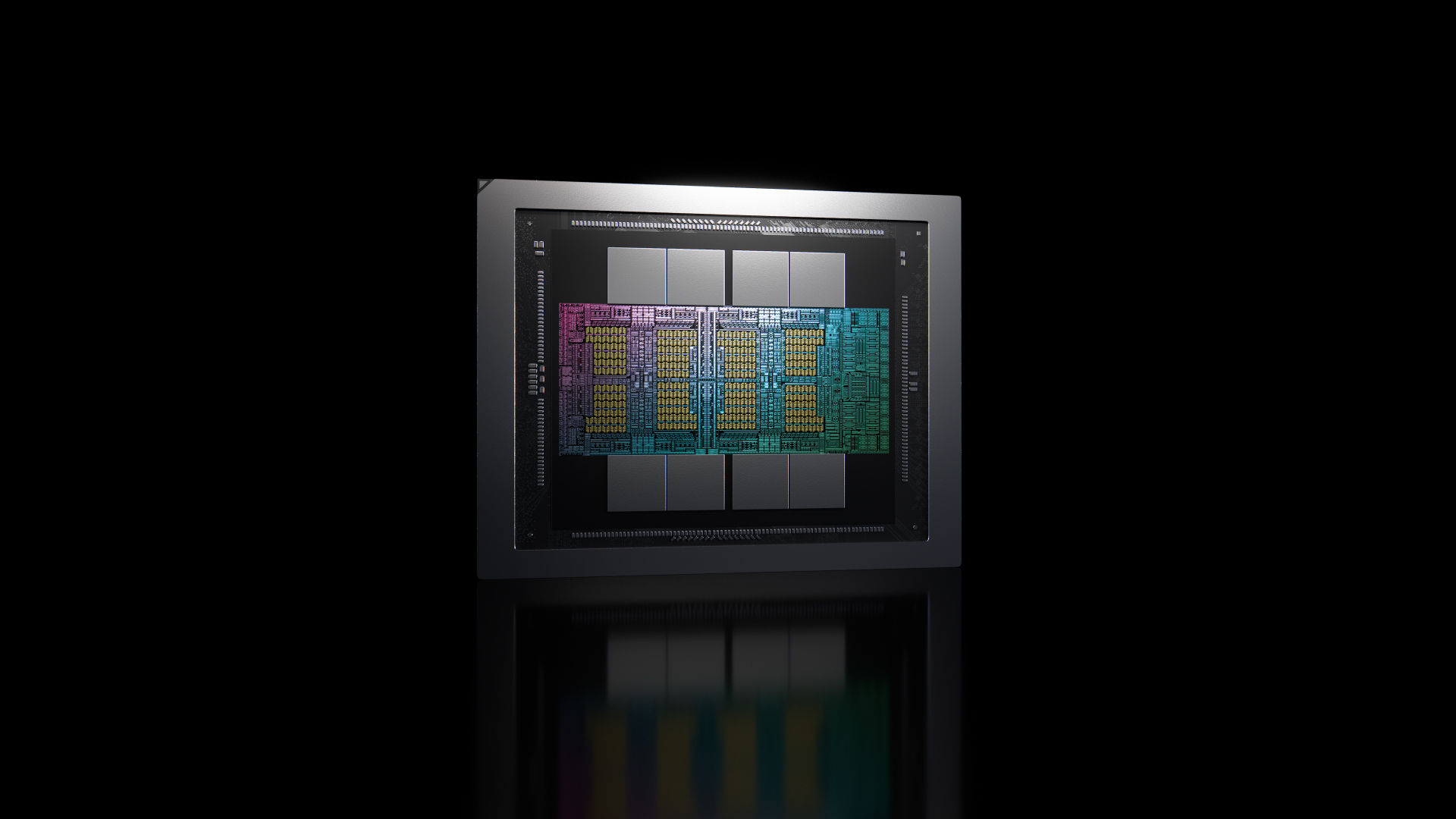
NVIDIA has announced Rubin HPC at SC26, introducing a GPU for its Vera Rubin platform with availability expected in 2028. The chip is designed to accelerate simulation and data processing across science, engineering and analytics workflows, putting its focus on computational research rather than a gaming feature set.
The headline specification is more than 50,000 CUDA cores on a single GPU. Rubin HPC also includes sparse data acceleration intended to keep those cores supplied with data. That pairing is central to NVIDIA’s stated approach: the company says the design will scale data movement alongside compute, rather than increasing computing resources alone. The important technical emphasis is therefore not just the core count, but how the architecture feeds that processing capacity.
Connectivity forms another part of that approach. Rubin HPC uses seventh-generation NVIDIA NVLink interconnect technology to accelerate GPU-to-GPU communication. Alongside the on-chip sparse data acceleration, this gives NVIDIA’s announcement two distinct data-movement priorities: supplying the CUDA cores and improving connections between GPUs.
NVIDIA also positions Rubin HPC as hardware for simulations used by agents to test scientific and engineering ideas, with the results helping guide their next steps. In that workflow, simulation serves as a testing stage within a larger research process, rather than simply an isolated calculation. That is the practical role behind the announcement: accelerating the computational work agents use to evaluate ideas and decide what to investigate next.